Hadn't been to Coaches by the Numbers (CBTN) in a while, so decided to stop by and do some catching up. Came across a very good article about one of my favorite coaches, Paul Johnson. Johnson has had some early success at Georgia Tech (GT), but has fallen on tough times here lately. Many rumblings can be heard in Atlanta, GA, but I think these are premature, and those doing the rumbling should read this article (found here).
Enough Already!
There's also some good reading to be found in their blog section (located here). I think CBTN site is a very interesting site for those interested in cutting through all the bullshit and want to get down to brass tax. Good job CBTN!
Hit'em Hard has some good reading on the 3-5. I almost went the route of the 3-5 many years ago and the defense still intrigues me to this day. Go here to get some more good information, from a very informative site.
Student of the Game has a very good article on attacking 8 man fronts with the flexbone. Very good read and a very good site, check out the article here.
Hope everyone had a good Fourth of July, I know I did! Enjoyed hanging with family and friends, and of course partaking in the usual brew or two. Happy Birthday America!
So what's on the agenda? Well, I'm looking at some Flexbone stuff, still waiting to hear on my job offer (which has me concerned, but I could still use the time off), dabbling in the 46 Nickel and writing about UF's Nickel Tracer blitz that helped them to the 2006 National Championship. I also really want to wrap my head around this 3-4 stuff, but can't seem to find very much in the way of reliable information. Most is collegiate, and very complicated to say the least. If you have a high school version of the 3-4, hit me up, I'm wanting to learn more!
For those pounding the weight rooms, your payday is coming. Less than a month away for some. Keep pushing the players, now's not the time to let up!
Team building is an often used, yet little understood axiom in the world of football these days. I want to take the time to look closer in to this all to often overlooked topic. I think coaches should invest as much time as they can in to building their teams, even if you feel your team is a tight knit unit, you can never really do too much team building.
Team building has many key elements, the most important elements, in my opinion are earning trust, communication, and teamwork. These elements can be built in many different ways, however I feel the order they are listed in above, is how you should approach team building. A great book, that helped me when I was a young coach was 101 Teambuilding Activities. This book is a must have for any coach that is about to implement an off-season team building experience in their football program. Let's look closer at these items.
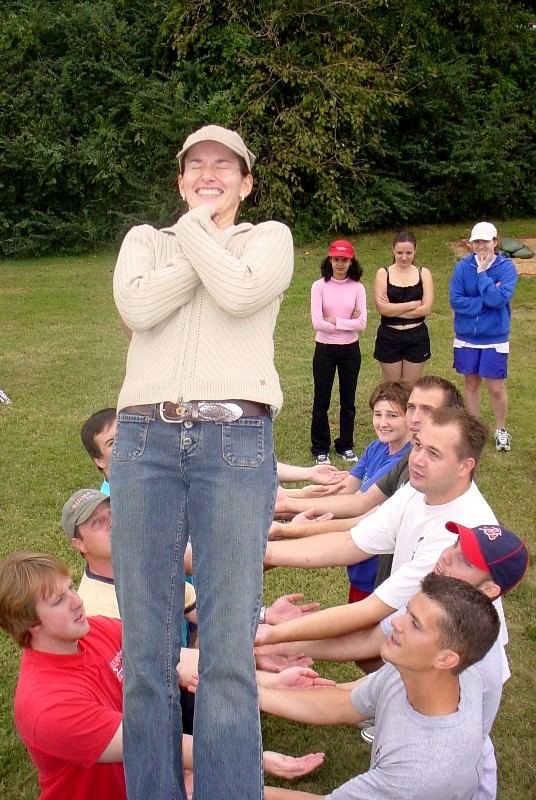
Trust I joked in my last article about trust falls, but I've actually done this, and it works quite well. Simply put trust falls involve either pairs or groups of players that are set up where an individual allows himself to fall and be caught by his teammates or teammate. Seems simple, but it's a very good bonding experience and is simple and easy to do. A twist I added, was that when I had the players pair up, every time a player caught another player he had to make the statement "I got you". This reinforced the element of trust between the 2 players.
Trust fall!
Another excellent trust builder is an exercise I called "What you mean to us". Every player was given sheets of paper, and at the top of the paper was a player's name on the team. This was usually done with the varsity only, and should be done in small groups as it does take some time. The players then write a positive element that their teammate brings to the team. The papers are then compiled by name and distributed to their owners to read. The idea here is that people are more likely to write things than say them, and it shows the important elements that individuals bring to the table as a teammate. I have left it at this stage, or even opened the floor for discussion. There is no right or wrong way here, the key is to keep things positive.
Be positive, stay positive...Banana Hands!
Another exercise is 1 you can do anytime, but is a very good graphic exercise. Take a box of toothpicks and wrap with a rubber band. Call up a player and have him try to break this banded group of toothpicks. As we all know, this will not happen. Now, call another player up, remove 1 of the toothpicks and have him break it. What this illustrates is that together we can't be broken, and are strong, however by ourselves, we are weak, and easily broken. Another way to do this, if you don't have toothpicks is simply to have a player stand up, make a fist and have another player come up and try to dig out 1 of his fingers and bend it (obviously not to the point of breaking it or anything). This will be nearly impossible to accomplish. After a few attempts, have the player who initially made the fist hold his fingers out and retry the exercises. Obviously this will end quickly as the fingers will bend easily. Again, this shows the team, separate we are vulnerable, yet together we are strong.
Can't be broken...
Communication As coaches all know, without communication, you cannot possibly achieve success. Communication is 1 of the most underrated skills that humans have. How many times have you seen a wide receiver on television get behind a defensive back for a touchdown, only to have the defensive back throw his hands up and argue with another teammate about what the coverage was? Clearly there was a lack of communication there. Here are some things I've used to facilitate and show the importance of communication.
Good communication is essential!
The old "telephone game" is a very easy way to show the effects of communication in a group setting. What I did was put the team in a room, then take one of the captains, and whisper in his ear a statement. This player was then to transfer this message to the next teammate. The message would get passed around the room until the final player was asked what the message was. 99% of the time, the answer you would get was not the original 1 you started with. This exercise shows the importance of listening, and how listening relates to communication. Another good idea is to also do this between the coaches. I did this when I was a head coach in front of the team. This showed the players the coaches were only human, and that we too had to work on listening to facilitate communication.
Learn to listen before you speak.
Another game I used to have the players play, was what I simply called the noise game. We would create an obstacle course, usually in the gym, but you can do it anywhere. Players were paired up with a teammate and one was blindfolded. The partners could not touch, and the commander (unblindfolded) player could not whisper instructions. The remaining members of the team would surround the obstacle course and would begin shouting when I blew the whistle to start. The objective was for the pair to navigate through the obstacle course from beginning to end with the best time. The commander could only give directional commands to the blindfolded player. If an obstacle was struck it was a 10 second penalty. What the underlying goal of this drill was is it taught players to focus on the communication by having to listen through the "noise" of the commander. It also had a competitive element to it as well, which made even more fun.
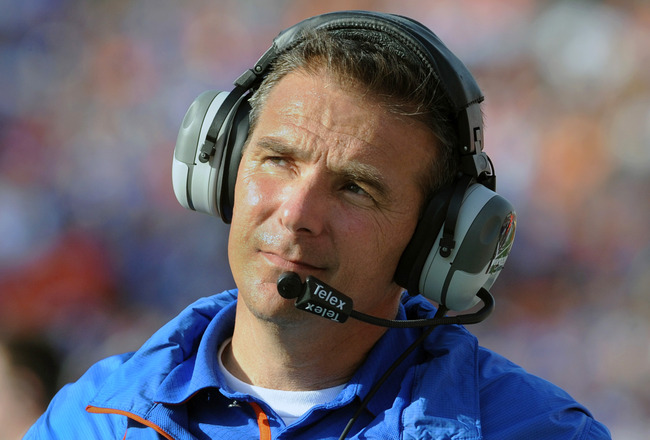
Teamwork There are a myriad of teamwork drills out there, and I've used several. The general goal of these drills is to see the group develop a leader, and then follow instructions, work through problems, use multiple ideas and work through problems for a common solution. There's one in particular where each team is equipped with a bucket of water, and a bungee cord. The goal is to navigate an obstacle course from one end to the other and dump the bucket of water in a larger bucket without spilling the contents. This drill involves creating a device, with only the supplies provided, that the group comes up with. You will easily see who the alpha males are and who are the followers. Too many alphas can lead to indecision and arguing. Not enough, or none at all, lead to indecision through lack of communication and effort. As a coach it's a great tool to see who sticks out as a leader. To the team, though, this is a chance for guys to step up, that may have otherwise been quiet or withdrawn. It also puts some of the players out of their comfort zone by forcing them to work with the others. All of these items are important to facilitating the development of teamwork.
Alpha Male
Again, I'm not going to list all the drills, as there are so many it would be pointless. The general idea with teamwork drills are what is paramount. Find a drill you can do, and then execute it. Always remember to evaluate the end result of every drill. This way, you have some ideas who may give you problems in the future, who you can lean on, and who you don't need to put too much pressure on. As you can clearly see, teamwork drills do more than just facilitate teamwork, they give you, the coach, a clear window into the leadership and cohesiveness of you overall team's framework. This is why it is so important to record the results, either written, or actually recorded (yes I've videoed these exercises).
Now, I'm going to step on my soap box here some, and if you don't care for religious views, click the little "x" at the upper right corner of the screen! The Fellowship of Christian Athletes (FCA) is a great resource when it comes to team building. FCA also does good with the building of individuals, and is the best resource I have found in all my years of coaching. Their camps are second to none when it comes to team building, and team building exercises. I went with the team last summer to a team camp, and what an experience! I felt our team came out of that camp much closer and more bonded than when it went in. I also felt, certain individuals really benefited from going to the camp, and got a lot out of the spiritual portion of the camp. You can go to these big college camps, or NFL camps, and get good at running the zone read, or defending the Air Raid offense, but those camps ability to help build your young men pales when compared to the FCA. Like I said, I'm "soapboxing" it here, so I apologize, but there's something to be said for a camp that you can work the game of football, and also receive a great spiritual message at the same time. Ok, I'm going to climb down off this soap box, and talk about some very good team building exercises I've done in the past.
I want to show how I rolled all the above into my preseason team camp. This camp was the highlight of many kids years, and marked the beginning of the fall, and football season. This camp was very important to our team for many reasons. Please read further and I will explain more about our preseason camp.
Team Camp At first look at the heading, most would think..."Duece, you've already mentioned this?!", however I'm not talking about a team camp you go to, I'm talking about team camps you host for your team only. I mentioned in a previous post (found here) about a team camp lock-in I did for several years when I was a head coach. I can truly say it was one of the best experiences I've been able to be a part of as a football coach. The basic layout of the camp was that the team would report in the middle of the week, usually on a Wednesday night. The team would come to the high school and check in to our gymnasium. Now, you have to remember, these guys were going to live here for the next 3 days, so they had to have bedding, clothes, towels etc. We made them live together with their position group, they could not group up based on who their friends were. We did this based on defensive positions usually and spread the guys out through the gym. I usually tried to get 2 coaches per position group (yes, the staff was expected to be there as well) so that there would be plenty of supervision. I had an orientation to let the players know of the rules of the camp, and we handed out our summer awards that evening after everyone had been officially checked in. Then we got ready to practice! At the stroke of midnight, we were on the game field with the lights on and practicing! We called it "Midnight Madness"! The basic layout of the day was 3 practices per day with 2 being 2 hours in length and one being an hour-and-a-half. In between this time was meals, free time, or speakers. I tried to get anyone I could to come talk to these young men, with most being local business men, or pastors of local churches etc. The best 1 I got was a young man who was born a paraplegic, yet managed to be the assistant manager at our local McDonald's. He talked to our guys about adversity, and how to handle adversity in the face of crisis. In the evening, after our last practice we would gather the team, and our resident FCA member (my JV offensive line coach) would work on team building. He had a message, and delivered, very carefully, through use of scripture. Obviously in today's world of separation of Church and State, you have to be careful, but we walked that line closely and quite well over the past 3 seasons. On the last night of the camp, we had Senior Night, where each senior would get up and talk about their time as a football player in the program, what they wanted to accomplish, and what they remembered most about their time in the program. This was a very important bonding experience between the older players, and the young incoming freshmen players.
The overall goal of the team camp was team building. In order to get the camaraderie that you are looking for, you need to take the players out of their comfort zone somewhat. I did this by having them room with guys they were not used to hanging out with. We also had them eat by position, instead of class, so they were not all mixed in with guys their same age. I had several portions of the camp that involved players getting up and speaking, which involved communication, and getting the player out of his comfort zone. I also did exercises that were mentioned above in both a teambuilding setting, and a football setting. Don't get me wrong, we did football, but for the coaches, it was a chance for us to take the temperature of our team, see how they got along, and where potential pitfalls could be.
I know the team camp seems like a lot to organize and you would be right to assume that. However, it is like anything else that requires hard work, it's worth it! You will find that players will look forward to this portion of the season with earnest, and participation is easy to come by. In our area, the rules said we had to have this open to the public, which was no problem, since we were rural we didn't share the camp with other teams. If you're in an urban setting you might have to get creative, but then hey, that's why we make the big bucks right?! Our rules also said participants had to pay admission, our camp was usually one dollar! We then turned around and used that money on a pizza or movie night during the camp. The basics here is that it's worth it to help develop your team. If you have any more questions on the team camp, email me, I can probably dig up an old brochure or schedule somewhere I can share with you. At the very least we can chew the fat about how to set one of these things up.
Well, news on the job front, I may be working after all! I have a friend who may be getting a local junior high head coaching gig, and wants me to head up the defense. I feel it's definitely a step backwards, however it's coaching, it's local, and it's not as pressure packed as the higher levels, which is what I need right now. We'll see, nothing is set in stone, but I have to get my head wrapped back around being a DC and what defense I want to use. The league is spread oriented, but spread to run, not spread to pass. I'm thinking either the 46 Nickel for it's simplicity or the 4-2-5, with 1 high principles utilizing Rip/Liz/Mable principles. Anyhow, that's what I'll be working on in the next few weeks. I do have a good post on offense (I know, been a while) that I want to share. Should be ready some time next week so check back in and see what you think of it.
Well, like I promised, I'm going to move on and discuss the actual workouts themselves in this post. I'd also like to hit on some other things I've done in terms of mini-camp applications, and overall ideas I've had about increasing participation in off-season workouts using competitions. One side note I'd like to add, for those thinking the summer workout is going to immensely increase your team's strength and size, I'm afraid you are greatly misgiven. In my years as a coach, the longest I've seen a summer program go is 10 weeks. This is just not enough time to develop a player, especially if it will be the first time they've picked a weight up all year. Football is year-round now, and so much training. The teams I have been a part of trained all year, both in season, and out of season. The summer is just one part of this year-round training. So without further adieu....
The Workouts Now I'm not going to sit here and tell you, that BFS, is the best, or anything like that. What I'm talking about in this section is the overall mood, tempo and atmosphere your workouts need to have. Utilize whatever format you want, there's so many out there no, they all must have some merit! I've done 4 day weeks (2 day upper body, 2 day lower body) as well as 3 day workouts with 1 day of practice, you name it, I've tried it. I'm going to break down things that should go in to your workout to help make your players want to be there. Every player knows working out is beneficial for them, however, as stated in an earlier post (found here), the teenager these days have tremendous time constraints put on them by all the activities they have to do around them. You are in a losing battle if you simply ask them to choose the weight room over their girlfriend, or making the almighty dollar! This is where you've got to get creative and innovative to keep the weight room and the off-season program lively and intense. So let's look at what a good workout should have in it to be effective at keeping today's football player attentive.
Meaningful exercises- This is important because kids nowadays have access to information available at their fingertips. Don't believe me, tell them something that's hogwash, and see if the next day they don't "sniff" you out. Young folks today seem to trust adults less and less, so even though they listen to what you say, they are going to try and see if you are for real, or just plain bullshit. What you put in your workouts, must correlate to getting better on the playing field, not just taking up time. Your players are already stressed for time, they don't want to sit through a workout that isn't designed to get them better. Give them what they need and they will want to be there because they can see how the workout is helping them get better on the field.
Matched partners- This is very important. You don't want your 5'5" 130 pound Junior Varsity (JV) running back lifting with your 6'3" 250 pound senior offensive tackle (OT)! Try to partner your players based on ability. This will give them someone to compare themselves and their achievements to. Some kids are easily intimidated, so lifting with a partner that is physically superior will become frustrating and can result in the loss of this frustrated player. Also, your stronger players don't benefit from working out with weaker partners, they need to be pushed too. Match these players up, irregardless of position, and let them push each other. Remember, competition is a healthy thing!
Variation- Workouts that tend to repeat themselves over time, begin to lose the interest of the young mind. Throw a curve ball in every now and then and have lifting competitions, or running competitions etc. The sky's the limit when varying up your workouts. The idea is to keep things in your off-season program from getting stagnant and dull. I have done any thing from have sprinting, passing, punting, kicking (the latter two being hilarious) competitions, to playing a version of "Bowden Ball" known as 4 on 4. Things were dull one day last summer in the weight room, and my offensive line (OL) coach decided to do a push up competition. What the heck, the kids were working upper body right?! One day out of the schedule doesn't hurt anything, and it keeps the players' interests peaked. Use your imagination and do this once a week, or do something different everyday at the end of the workout. Whatever you do, don't let your workouts become dull and repetitive!
Dynamic- Your workout needs to adapt to the varying levels of player you may have in your weight room/gym/practice field at any one time. I always tried to mix up times for when JV and varsity lifted, but inevitably you had some kids mixing in. Try to keep these skill levels separate and different if possible. The younger player needs more teaching and technique, whereas the older player already has this, and needs less teaching and more individual workout time. This goes back to having a good staff (found in my first post here) that can allow different coaches to be spread throughout the workout area helping and aiding these different skill sets. The scheduling of workouts also needs to be dynamic. Obviously if you can do it, schedule the JV and varsity separate. I always had JV come in at 3 P.M. and workout until 5, with the varsity guys coming in at 5:30. This gave the older players time to get off work since most of them had summer jobs. Sometimes you can't do this. I have a friend that has the weight room open three times a day. He opens it a 6 A.M. for the guys going to work who want to work out early, he reopens at 1 P.M., and then has a late session beginning at 5 P.M. This flexibility allows your players to get to their workouts regardless of what their schedule is.
Tempo- Workouts should move and flow about in either the weight room, out on the track, or in the gym. One of the worst things a coach can do is have dead time. Dead time has the mind wandering and thinking of other places the player could be. This in turn, leads to doubting why they are there in the first place. If you keep em' moving, and working, they won't be drifting off to "la-la land" thinking about that new movie, or the new video game that just game out. Just like in football practice, tempo is completely up to the coach. I have done "prison style" workouts where coaches have counted every repetition, and I've also allowed the players the freedom to move about on their own. What I've usually done is explain that the players will have the freedom to do the workouts on their own, as monitored by the staff, however the first sign of loafing and we are doing the prison workout. I usually had to do a week or two of prison workouts every summer, however that's all it took to get the players back on task! If you are out on the track or field, set up all drills prior to player arrival, this way there is no down time when you are conditioning or running routes, or agilities. Keeping the tempo up also ensures that the workout will quickly and smoothly, thereby getting the players back to their daily lives. Remember, these are NOT college athletes here, they have not devoted their life to the game of football. Don't make working out a burden, make it a necessary evil, and then add some fun in as you go!
Keep up that tempo!!!
Mini-Camps
For those that are allowed to, mini-camps are a great way to break up the monotony of the summer workout. I used to hold a few of these each summer, with a very large one at the end of the summer. I'm going to share with you what I did, and hopefully you can find some of this quite interesting.
Position-specific mini-camp- I have held several of these through the years. All it is, is simply having a position, or group of players arrive early or stay later and work on position-specific drills. Early on, when I was a defensive coordinator (DC) and defensive back's (DB's) coach, I had my DB's stay about 15 minutes after every workout session to do footwork. Other coaches hopped on the bandwagon and did the same thing. I've also had mini-camps I would do during the day and have all the incoming freshmen come in and participate. This is an excellent tool at evaluating your JV talent, and it gives an opportunity for the younger players to soak in the offensive and defensive schemes without the fear of messing up with the older kids around. As with any of this, whatever you do, have a plan and work the plan. Each mini-camp should have a target goal of what you want to achieve.
Conditioning mini-camp- I did this mini camp as it got closer to the end of the off-season. I wanted to do this to get the players acclimated to the heat and stress put on their bodies by having to perform in the heat. I've done anything from simple sprints to plyometrics, the content is not the issue here, it's the actual camp itself. I think this camp really benefited our lineman, who were packing on the weight and lifting heavy, become acclimated to the heat and begin to get used to carry around their new body weight.
Team mini-camp- I did this the past 3 years, and it is a TON or work, but well worth it. I basically had a "lock-in" format where players reported to the school on a Wednesday evening. They were instructed to bring all the necessary items they would have to have on a camping trip, as they would be living in the gymnasium. Players would check in from 7 P.M. in the evening to 10 P.M. that night. Then all the gates would be shut and locked. No players could have vehicles on campus. They also could not leave without a parent present (we rarely had anyone leave). For 3 days we lived together, ate together, and slept together at the high school. What a team building experience! To this day, I still have players saying how much they enjoyed, what we called our "Fall Camp". It wasn't just football either, we had several guest speakers, and business and organizations from around the town prepared the meals. We also watched movies, and special FCA events as well. Some of this might not fit where you are at, but for the team building aspect of it, there was nothing better. I may, in a later post, go into the details of what we did, and how we accomplished it. Send me email or comments if you'd like to hear more. Basically, we got 3 good days right before the "official" start of the season to condition and go over the mental portion of the game that seems to get so rushed in the early days of fall camp.
Not everyone can do a mini-camp, or pre-season camp. However, if you can, I recommend it, if for nothing other than team building. Check your state rules and regulations regarding this matter and see what you can and can't do. Whatever you CAN do, will go a long way to helping your team in the fall.
Competition Creating competition is something that's been thrown about the past few years, with little to no "real" explanation. Most of us, as football coaches, know what competition is, the problem is how to incorporate into your summer lifting and conditioning programs. I will share some things I have done, and some things friend and colleagues of mine have done and you can go from there. The sky's the limit though when it comes to this type of stuff, so use your imagination.
One of the first things I did, when I got my first head coaching job, was to try and establish toughness, and find who my toughest most physical players were. Well, what better place than on the wrestling mat! We would pair guys up by position and have them wrestle. At first, we didn't do it for long, 45 seconds or so, as most guys tired out very quickly. Wrestling opened up all kinds of information on our players, such as who the alpha-males were, what players were "naturally strong", who was in the best shape etc. It also doubled as an excellent version of conditioning.
I also divided the entire team up into off-season teams and we had several competitions that we coined as our "Summer Challenge". At the end of spring football, we gathered our players in the cafeteria and had a mock draft. Seniors who had made all their off-season lifting commitments or had been a part of a sport, were selected as captains. We usually averaged around 10, 10-man teams. Each team had to have at least 1 freshman, and 1 offensive or defensive lineman. Then we arranged the picks and put together the rounds. At the very end, each team also got to draft their coaches as well (this was quite hilarious at times). Once the teams were assembled we took down the names and established a contact list. It was the captain's requirement to stay in contact with his team. The Summer Challenge consisted of teams competing in different games/functions throughout the summer to gain points. The team with the most points at the end of the summer won. Usually this consisted of an article in the local newspaper, a T-shirt, first in line at meal time, and first to pick out their equipment for the fall.
To gain points, the teams were graded on the following items:
Weight room attendance- each team member, got 1 point for every day they were in the weight room.
7 on 7/Lineman Games attendance (will talk more about this later)- each team member got 5 points for attending these events.
For every pound a team members max went up, they got 1 point, for every pound the max went down, a point was deducted.
Attendance at camps- team members who attended summer camps and team camps were awarded 10 points for every camp attended.
4-on-4 game attendance- We played 2 games per week and players were awarded 1 point for attending and participating in these game.
Miscellaneous- a team member could be awarded up to 5 additional points for miscellaneous items such as working youth camps, fundraising, or simple things such as helping to inventory equipment etc.
What really made this go, was giving the captains the contact list of their team members. This allowed the captain to call a guy who was not showing up and put the pressure on him. Now, instead of a coach calling and bending a player's ear, it was a peer doing so, and the players were more apt to show up. We saw our average number of players in the weight room soar from just under 25 per day to around 45 per day after implementing our Summer Challenge. Players who were known for skipping out on weight sessions began to show up and participate. I cannot tell you the benefits we reaped from doing this, and even though it does take some time and effort, it is well worth it.
Make peer pressure work for you, not against you!!!
One item listed above that was a helped create competition was our 4-on-4 football league. This was interesting, and took some time to develop, but it really boosted our weight room attendance. 4-on-4 is basically touch football played by teams of 4, the field length being the standard width of a normal football field (53 1/3 yards). The width of the playing field is 25 yards. The field is divided in half, and the end zones are standard 10 yard deep endzones. All of this can easily be marked with cones or pylons. Players have 3 downs to get across midfield, and then an additional 3 downs to score. The ball has to be snapped by a center, and you must have one additional player on the LOS at all times. Once the snap is started the quarterback (QB) has 7 seconds to get the ball off or it is counted as a sack. Completions cannot be advanced, and the ball is down where the pass was caught. Interceptions and fumbles are dead where they occur. There are two 15 minute halves that have running clocks, and a 5 minute halftime. That's the basics, if you want to learn more about it, email me, and I'll give you what I got.
I also did a 7 on 7 passing league with some teams around our area. I was hesitant to do this, as we did not have the best facilities in the world, but I'm glad I did. The 7 on 7 league did 1 of 2 things, it had us competing with other teams, which we all know is better than just competing against yourself, and it allowed us to raise money. We charged a $200 entry fee, and also had a concession stand open during the games.
They do it...
Being a former offensive lineman, I didn't want the big guys left out, so we also had lineman games. The cost of the linemen games were a part of the 7 on 7 fee, so we had quite a crowd around our place one day a week. The linemen did everything from tire flips, to lifting competitions, sprints, and even a truck pull around the track!
Like I said in the beginning, use your imagination, and you can see where you end up. Our weight room attendance more than doubled from the time I took over, until I left, and I attribute it to the items I listed above and in my first post (which can be read here). You have to make your off-season workouts the place to be, or else you won't get your players in there.
In my next post, I'm going to talk about 1 of the most important elements of a good summer program, and that is team building. If you aren't using the summer to build camaraderie amongst your team, you are wasting valuable time. I hope these have been informative and if you have ideas you have used, post them in the comments section, or email them to me, I will feature a "readers post" section if I can get enough ideas in here. Keep forging ahead with your off-season programs guys, fall will be here before you know it!