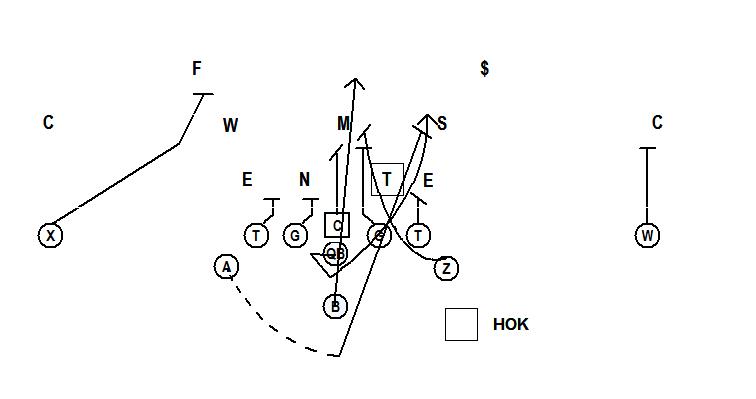
Showing posts with label midline. Show all posts

Thursday, November 3, 2011

Flexbone and the B back-The Running Game


After our first installment on the B back, we now know what we need for the position, but we now need to give him a job description.  I do this with all positions whether offense, defense, or special teams.  So, what is the B back's job description?  Well, the B back's main role in the offense is the dive back on the triple option.  A typical fullback is usually not utilized as a runner, and you will find that blocking is not a top priority of the Flexbone B back.  Being able to run option plays such as midline, inside veer (ISV) and outside veer (OSV) are essential (again this goes back to the first post on what we are looking for in our B back).  The B back is not a "driller" either, he must be able to cut back and make quick cuts on the zone dive play.  I have also utilized the B back as an outside runner on option plays as well.  Lastly the B back does need to block some.  He will be called on a lot in pass protection as he makes up the 6th in our 6 man protection schemes.  He's also the C gap blocker on sprintout passes as well.  The B back, for me, has also needed the ability to catch passes as I run the waggle off the Rocket toss play as well as middle and off tackle screens to the B back.  As you can see, the B back in the Flexbone must be a pretty versatile player.  Let's look closer and some of the common run plays the B back is involved in, and also plays used to keep the B back involved in the game.


Option Runs
The B back is involved in several of the Flexbone option runs.  These include the following, midline, ISV, OSV and speed option.  For those that run trap and trap option, the B back is obviously a part of this as well. 

Inside Veer/Triple Option
The B back is the crux of the triple option.  He is the man that you must get established to make it all go.  The defense must honor the give to the B back.  Listen to any good circle of defensive coaches, and you will hear the phrase "You must take away the dive".  Nobody wants to get beat by a running back (RB) pounding it up the middle on you all night, well, this is EXACTLY what the B back is for.  Quickness and toughness are essential to any B back if they are going to helm make the best play in football go!


Midline
Midline, is my favorite play in all of football.  I don't believe there is another play out there that hits with the quickness of the  midline out of the Flexbone offense.  This is where the B back's quickness comes into play.  Toughness is also shown here, as the B back will be running right into the teeth of the defense.

Outside Veer
Though not a staple of many Flexbone offenses, the OSV is one the B back must be able to run.  With the modern day twist on defense switching back to that of the odd front, the need is there for a TE flank and the ability to run OSV putting the defense in conflict.  The B back's role on OSV compared to ISV is no different, especially the way I run it (for a later post, email me to discuss if you'd like).  Nonetheless, the B back still has to utilize his strength and quickness when running the OSV, just as he does with midline and the ISV.


Speed Option
Johnathan Dwyer at Georgia Tech made a living on the speed option, due in part to him being such a fantastic athlete.  If you've watched Paul Johnson's teams as long as I have, you know the speed option is a great play, when your B back is a home run hitter.  A few years back I had a B back that could fly, he was small but super explosive and ran the ball well inside or out. I dusted of the speed option, to a tune of a 7.7 yard per average carry on that single play alone and 9 touchdowns that year.  Our QB was a good runner too, so it was truly a double option threat!  If your B back is more of a straight-ahead power runner, then the speed option might not be for you.  However, if you think your B back would do good out on the edge of the defense, I suggest you run this complimentary play.


Complimentary Plays
Any good defense is going to take away the B back at some point during the season.  Having complimentary plays is what keeps the B back involved in the run game, and a viable threat when running the triple option.  I'm going to list some plays you can use to help keep the B back involved in the run game when the defense is taking him out of the triple option equation.

Zone Dive
The zone dive is the play that is designed to keep the B back involved in the run game when the defense has done a good job of taking away the dive portion of the triple option.  Very simply put, the zone dive is the Flexbone's inside zone play.  There is no read, and all the OL zone block, including the PSSB.  The BSSB goes in motion just like the regular triple option play and runs his normal pitch course.  The B back will take a flat step, instead of a straight ahead attack step as he does on the triple option.  This is so the B back can get a good read on the playside guard's (PSG's) block.  Once this "read step" has been made the B back squares his shoulders and either stays on track or cuts back, but must NEVER bounce to the outside.  The QB will bring the ball back as deep as he can so the ball is in the B back's hands as long as possible to help with the B back's read on the defense.  This also helps with the illusion of the play being the standard triple option play.  Once the QB disconnects with the B back, he then carries out his option fake. 


Iso
Iso is a play I got from the University of the Cumberlands staff about three years ago.  It is zone dive, and OSV wrapped into one package for them.  They have used it with great success in recent years, and I took it and completely removed the Zone Dive from my playbook.  Iso blocking was something my players know from running the counter-iso play.  So, there was no new teaching for anybody on the offense.  The only new teaching came from the footwork of the B back, and the QB not having to read anyone.  The QB delivers the ball as deep as he can to the B back, the exact same way the zone dive is run.  Once the ball is seated, then the QB and backside slot (BSSB) carry out their option fake.  The playside slot (PSSB) folds underneath and blocks first LB to the playside.  The OL is iso blocking to the playside and scooping to the backside.  The only difference from ISV to the Iso play is the first step of the B back. Instead of attacking downhill, the B back will take a lateral step, and then attack the outside hip of the playside guard (PSG).  This allows the B back to read the blocks and be prepared to make a cut quickly, just as the Zone Dive does, but without having to teach zone blocking.  This is a very good play, and I recommend that you add it to your playbook...TODAY!!!!


Trap
I've never been a big proponent of trap or trap option, however it is a part of many Flexbone schemes.  My guards have always been the large immovable objects on my OL, and not usually known for pulling well, so I've strayed away from running trap or trap option.  If you have the guards to do so, and you run a lot of midline, I suggest adding the trap in, especially if you are facing a hard to read three technique.  The trap puts a "squatting" or "sitting" three technique in conflict as with the trap block it automatically declares the tackle to be a B gap player.  Again, if you've got the guards, and you run a lot of midline, I suggest adding trap to your repertoire.


Draw
A great play off sprintout action is the sprint draw.  In years where my B back was more of a rushing threat than my QB, I have used this very play.  It's very successful, and can really crease the defense if you are good at sprintout passing from the Flexbone.  The B back sets up as if to block on the play, but then quickly slashes back running to daylight.  I have seen huge gains off this play from both the B back and the QB.  Even though it's not known as a passing offense, a good draw play is a must in any playbook.

There are many other ways to keep the ball in the hands of the B back, you can use screens and quick passes to him coming out of the backfield.  The plays listed above are ones you can use to keep your play maker involved in the game, even though the defense is taking him away from the bread and butter option plays.  You can also use the complimentary plays to hurt over-aggressive defenses who are being unsound against your option plays.  This ability to keep the defense honest, will allow you to run your base triple option plays successfully.


I certainly hope you enjoyed the installment on one of the key elements to any Flexbone triple option attack...the B back!

Duece

Friday, July 22, 2011

Manny Diaz Fire Zones, Two-a-Days, and other Shizz...


Fire Zones Bitches!!!
Well, I've had my nose to the grindstone working on the book, so no posts here lately.  I have an opinion post I'm yet to unleash, as it was emotionally written, and I want to be careful not to have too many of those on here.  Anyway, some latest stuff I've been looking at are:


Work it baby!

Coach Hoover has once again done a great job, with Manny Diaz's Fire Zones.  You've got to read this article if you are FZ guy.  I wish when I was doing all those FZ's some years back I could have read this, a very helpful and useful guide.

Hit em' Hard has a great little post on Two-a-Days and some things you should look into when you start fall camp.  Fall camp is right around the corner so this is some good reading for those fixing to hit the gridiron.


2-a-days, right around the corner!

Coaches by the Numbers has some good analysis for all you Colorado fans out there on Dan Hawkins...ouch!  I will say this, there's more to a good head football coach than just the man himself.  Look what Urban Meyer was without both Dan Mullin and Charlie Strong!  Maybe Urban's not as good as we thought either!  Or maybe it takes more than just one man to be run a successful football program.  I think the latter is the one I'm going with.  Anyhow, CBTN is a great analytical tool you need to check out!


Damn!  Why did you leave me????

Ride and Decide has a good article on midline and all the tags you can add to the play.  You can also go here and read my midline article to gain some insight as well.  Great articles on one of the greatest plays in all of football!

Also, from Ride and Decide I found Gridnotes!  Gridnotes is a good place to keep up with what's going on in all of the football blogs.  A great idea, and a must see site.  Keep up the good work of keeping us informed.

I also recently found Becoming a Man For All Seasons.  This is an informative and well-written blog that has good information both schematically and philosophically.  Check it out, it's worth the read!

So, basically that's it, just wanted to check in and let you know what's going on out there.  Like I said, I'm working on the book, so postings will be few and far between, but hey, football season is upon us, and you should have done all your reading by now!  Soon the click clack of cleats will be heard in the hallways, and the smell of sweat mixed with fresh cut grass and August's heat will fill the air!  IT'S FOOTBALL SEASON BABY!!!  Time to get after it!


Good luck coaches! 

Also on a side note the contact email has changed to footballislifeblog@yahoo.com.  Give me a shout anytime, I check it daily.

Later,

Duece

Wednesday, July 6, 2011

Paul Johnson's "If-Then" methodology to Triple Option Football


"Tell me what did the pitch key do?"

A lot has been made over the past few years about Paul Johnson's triple option offense.  However not much has been made about "the process" in which the man calls plays and attacks defenses.  For years Coach Johnson has made fools of even the best defensive minds, including, but not limited to, Mickey Andrews, Bud Foster, and Randy Shannon.  Exactly how does Johnson go about attacking opponent's defenses?  There is a method to this man's madness, and it is simply known as his "if-then" sheet.  This post will elaborate on the thinking behind the triple option gurus like Johnson, Niumataolo, and Stowers to say the least.  Let's look at the actual sheet, and from there I'll break down the different scenarios bit by bit.

Follow the link here to my version of the "if-then" sheet and follow along and I'll explain the reasoning behind each decision.  Please note, Johnson's version is much shorter, and obviously uses his terminology, so I will elaborate on my terminology as we go, so bear with me.  So, let's move on with this and dig deeper into the  mind of a triple option offensive coordinator (OC)!

    
    Fear the Veer, or midline, or Rocket, or...
    
  • IF-Defense in 8 man front
    • Then- Run over (ends unbalanced).
      • Reason- To gain a 1/2 man advantage.
        • Explanation- 8 man fronts, have to get a little creative when adjusting to end over formations.  This can leave them vulnerable to triple option to either side.  To go even further into damaging an 8 man front, run twins over, with a slot on the LOS (shown below) to keep both receivers eligible.  When running ends over, look for the free safety's declaration, and run opposite.

    Ends Over
Ends over formation, both ends eligible

  • IF- Force players on the line of scrimmage (LOS).
    • Then- Run Tight (Nasty split double slot).
      • Reason- You gain blocking leverage by bringing in the wideouts. 
        • Explanation- The wideouts can now effectively crack block your force players, thereby out leveraging the defense and getting to the perimeter.

    
    "Nasty" Split
    
  • IF- Facing odd stack (5-3 look).
    • Then- Run tackles over unbalanced (Heavy).
      • Reason- Unbalanced looks give odd stack teams trouble.
        • Explanation- Odd stack fronts have some trouble adjusting to unbalanced sets that are unbalanced with a 3 man surface.  Similar to the ends over example (8 man front), look for FS declaration and run opposite.  Also, if you can outflank the DE/invert, run outside with crack blocking to that side until a DB becomes "nosey" attempting to stop the run.  Run veer pass when this DB has become a problem.

    Heavy
  • IF- 2 or 3 technique playside.
    • Then- Run midline.
      • Reason- A gap bubble.
        • Explanation- A gap is open, with B gap defender to read.  No need to run triple at a 3 technique when you can run midline.  Force the defense to get into 2I's, so you can run triple again (B gap bubble).
  • IF- No 2 or 3 technique playside.
    • Then- Run triple.
      • Reason- B gap bubble (same reason as above).
        • Explanation- Triple is what we are here to do, if the defense gives us a soft B gap, we are going to attack it with the triple.
  • IF- Handoff key turns shoulders ("sitter"/squat technique).
    • Then- Run zone dive.
      • Reason- Cloudy read.
        • Explanation- When a read key is giving your QB fits, block him.  Remember "Easy to read = hard to block, hard to read = easy to block.  Since a squat technique is hard to read, he's easy to block.  You can also run load or toad (tackle load) option at him (basically triple but fullback or tackle blocks handoff key).

    Zone Dive
  • IF- Pitch Key turns shoulders (squat or sitter technique).
    • Then- Run Rocket.
      • Reason- Force player has lost leverage by turning.
        • Explanation- If the pitch key is turning and squatting, he will not be aggressive enough to force the Rocket toss, thereby allowing us to outflank him.

  • IF- Secondary rotates with motion.
    • Then- Run counter iso/option.
      • Reason- No backside force player.
        • Explanation.  Teams that jump motion, often put themselves in a poor position in that they lose their backside force player.  This is a gamble by the DC, make him pay for it, by catching him a man short at the point of attack (POA).
        • Counter Iso

  • IF- Secondary rotates with motion (2).
    • Then- Run triple pass or waggle (off Rocket action).
      • Reason- No seam player (triple pass); Curl/flat player out leveraged (Waggle).
        • Explanation- Triple pass catches them with the seam player coming at the LOS and waggle catches them with the curl/flat player caught inside off run action.

    
    Veer pass (Vertical or Whip Route)
    
    Waggle off Rocket Action
     
  • IF- 4I's.
    • Then- Run midline.
      • Reason- Handoff key too far removed from POA.
        • Explanation- Midline at a 4I is dangerous.  Even better is midline triple.  The 4I is simply too far removed from the action to be effective against the fullback (FB).
  • IF- Double Eagle (TNT) look.
    • Then- Run Rocket.
      • Reason- Numbers advantage on the perimeter.
        • Explanation- Double eagle puts too many people in the box to run between the tackles, so test the flank.  If they over load to force they are weak on playaction.

    Rocket vs. Double Eagle
  • IF- Triangle (3 in box outside the B gap).
    • Then- Run zone dive.
      • Reason- Numbers advantage inside.
        • Explanation- Teams that attempt to put players on the edge of the box are weak in the middle, run zone dive to exploit this weakness.

    
    Triangle
    
  • IF- Force players on the LOS.
    • Then- Run Rocket with switch blocking.
      • Reason- Blocking leverage.
        • Explanation- By cracking the force player you now have leverage on the perimeter.
  • IF- Defense is blitzing.
    • Then- Run Rocket.
      • Reason- Soft flank.
        • Explanation- Defenses that blitz the triple, find themselves with weakened flanks and poor pursuit angles on quick hitting plays such as the rocket (and we don't have to block anything from a 5 technique back, which includes your blitzers).
  • IF- Stunting.
    • Then- Run zone dive.
      • Reason- Cutback run.
        • Explanation- Same reason teams run inside zone, to eliminate the effectiveness of stunts, zone dive does the same thing.
  • IF- Middle of the field closed (MOFC).
    • Then- Run 4 verticals.
      • Reason- Attacks the seams and FS with 2 defenders in his zone.
        • Explanation- Now I know all the haters out there will say 4 verticals are not a problem, but you got to try it vs. 1 high teams at least once a game to show the opponent you DO have the balls to attempt it.  Very important for slots to run down the hashes and the receivers to run down the field outside the numbers.  Also very good from a trips look to, as most teams will overplay their FS to trips.

    
    4 Verticals from trips look
    
  • IF- Linebackers overpursue.
    • Then- Run zone dive, counter iso/option.
      • Reason- Numbers advantage away from action.
        • Explanation- Counter iso was our bread and butter, as it makes teams pay for overpursuit, and it doesn't tip off overpursuing defenders by pulling linemen.  Make the defense pay for trying to cheat and get guys across the midline!
  • IF- Taking away FB.
    • Then- Run zone dive or speed option.
      • Reason- Keeps the ball in FB's hands.
        • Explanation- The FB is 1 of your best runners, you need to find a way to keep the ball in his hands even if the defense is doing a good job taking him away from you on triple and midline. 

    
    Speed Option
    
  • IF- Stunting A gap.
    • Then- Run triple.
      • Reason- B gap bubble.
        • Explanation- We want to run triple to a soft B gap, so let them stunt to the A.
  • IF- Stunting A and B gaps.
    • Then- Run zone dive.
      • Reason- Zone blocking/cutback run.
        • Explanation- Again, let them stunt, zone blocking was made for this, and it keeps your best runner with the football in his hands.
  • IF- Stunting A, B, and C gaps.
    • Then- Run Rocket.
      • Reason- Soft flank.
        • Explanation- Anytime the middle is mass confusion, run outside.  Stunting and blitzing can be controlled by the old adage "Run where they ain't".  Rocket does this, and does it by not blocking any "box" player playside, thereby getting more offensive bodies to the perimeter to block and already weakened flank.
  • IF- Odd front with 4I's.
    • Then- Run Loop scheme.
      • Reason- Read 4I, put him on island.
        • Explanation- A lot of odd front teams are going to this look, running loop scheme can still keep the triple option a viable part of your offense, just watch the beating your FB will take due to the proximity of the handoff key.  Keep the 4I even more confused by running loop trap and midline at him.

    
    Loop Scheme
    
  • IF- All inside gaps occupied (Bear look).
    • Then- Run Rocket.
      • Reason- Outnumbered on the perimeter.
        • Explanation- Teams that load the middle, leave the perimeter soft, make them pay by running the quickest hitting outside run in all of football.
There's a lot here I've added through the years, but the original "if-then" sheet is there.  A lot of it is repetitious, but I did this b/c in the heat of battle you don't want to be searching for your answer, so I felt like repetition was a good thing. 


Now that's repetitious!

The basis is simple, Paul Johnson wants to run the triple, whatever you do to take that away, he's going to make you get back to being honest with every other play in his playbook.  That's the beauty of his spread option offense.  It's not a myriad of plays with no rhyme or reason, there is clear focus and goal in mind...run the triple option.  If the defense takes that away, then they are vulnerable elsewhere, attack their weakness.  The "if-then" sheet will help the triple option OC, find his answer quickly when his team is having problems.  It allows the OC to have an immediate answer that is built into the offense.  This is why you see early in games, defenses seem to have an advantage against Johnson, but after a series or 2, or at the very least after halftime, he's found his answer, and begins to make defenses pay. 


Say Uncle...

The simplicity of the system is the beauty.  You can run this offense with little to no game planning.  After running it for 2 years, I quit watching game film of our opponents because we were seeing the "defense of the week" and what I was seeing on film really didn't matter.  The "if-then" sheet gave me immediate answers to this "defense of the week" mentality and allowed us to adjust on the run.


Did someone say "simply beauty"?

I hope this was helpful, and if you have your own "if-then" sheet please share it with us, always looking for more ideas!  Ok, Vassdiddy from the Huey board has gotten my interest peaked on writing a peice about the University of Florida's Nickle Tracer (Auburn fans will know this as their Heat blitz).  So I'm digging through boxes of clinic notes trying to find some stuff.  If you have any suggestions hit me up, will discuss and see what I can come up with.


Sit down sucka!!!!

On the job note, I may be going to a local junior high to be the defensive coordinator.  Nothing is set in stone, but it does look promising.  Haven't coached that age group in a coon's age, but hey it's coaching right?  Looking to run the 46 Nickle as they are in spread to run league, and I had hella fun with that defense last season.  Plus if my gut keeps getting any bigger, I will look like a shorter version of Rex Ryan!  Hope everybody had a happy 4th, season is right around the corner!!!!


GET SOME!

Duece

Monday, March 14, 2011

Midline


Midline, is probably my favorite power play in all of football.  It combines the power running game of the I formation and the option reads associated with triple option offenses.  Midline can frustrate even the best defensive coaches and teams.  Midline gives the option offense the "in your face" right at you power offense that some option offenses seem to lack.  If you already run the triple option, then midline is a must in your offense. 


The Basics


Midline has many variations (as we'll see) but in a nutshell, it is an option play that hits in either the A gap or the B gap of the defense.  The quarterback (QB) will read the first down lineman from the A gap out as the handoff key (HOK).  The QB will give the ball to the fullback (FB) every time unless the HOK comes down to take the FB.  If the HOK does take the FB, then the QB will replace the HOK and run the ball into the B gap.  The aiming point for the FB is the "brown spot" (use your imagination fellas) of the center.  If he gets the football he should be taught to "bend" the ball back in behind the HOK.  If the play results in a pull read, he is to absorb the HOK as he runs his dive course.  The perimeter blocking is where the bulk of the variations lie with the Midline play, however Midline may be run as both a double and a triple option.

The blocking for the offensive line is very simple, and here is an excerpt from an option playbook on how the offensive line should block the play:
  • Playside Tackle (PST)- On to the outside (don't allow defender to cross face).
  • Playside Guard (PSG)- Inside gap, Ace to backside linebacker (LB).
  • Center- On, backside gap, Over.
  • Backside Guard (BSG)- Scoop (Inside gap to backside LB).
  • Backside Tackle (BST)- Hinge, protect B gap run-through.


The Many Faces of Midline

For me, midline was not just one play, but one play with tons of variations.  I'm going to elaborate on the many variations to one of the greatest plays in all of football.

Midline Blast

The blast play is often times referred to as the midline lead play.  This is option football and power football meshed into one.  On the blast play, the reads for the QB and the path for the FB are unaltered.  The perimeter blocking for this play is what is key.  Both slots will insert themselves into the B gap.  The backside slot back (BSSB) will go into "tail" motion and will lead through the B gap, and is taught to block the outside 1/2 of the B gap, or the B gap to the outside (however you prefer to teach it).  The playside slot back (PSSB) will insert or fold into the B gap, and will block the inside 1/2 of the B gap.  The blast play is a great short yardage play and is also very effective on the goalline.  This is the first midline play I install in my Flexbone offense.


Midline Blast


Midline Seal

Many defenses have their LB's key the slot back's movements and react accordingly (you can go here and here to learn more about how the 4-3 defense does this very thing).  This can really make running the blast play, mentioned above, very trying for the offense.  So what is the offense to do?  Give the LB's false keys!  All the rules for blocking are the exact same except for the slot backs'.  The BSSB, will still tail motion and insert into the B gap, however he has the entire B gap to himself.  The PSSB will, instead of folding, load, or seal block the playside LB.  This keeps the playside LB from being able to collapse down inside and clog up any inside running lanes.  The Midline Seal is a very simple and easy addition to the Midline run game.


Midline Seal/Load


Midline Fold

The fold play is another variation of the Midline that plays on the keys and reads of the LB's and secondary.  Some secondaries will have their safeties cross key the slots, and when they see a slot insert, the safety will also insert himself into the inside run gap.  With the Fold play, the PSSB will fold or insert into the B gap, blocking the first threat to show in the B gap.  The BSSB is simply a decoy, he will go into tail motion and on the snap will simply run the pitch course, thereby drawing the safety outside and away from where the ball is being run.  This is a great compliment if you run a lot of midline triple option (or as some call it mid-veer).  This is also a great play to run with "twirl" motion to counteract any defenses that like to jump the motion associated with the Flexbone offense.  Again, as you can clearly see, the Fold play is an easy addition to your Midline arsenal, by simply changing a few rules, you can really distort a defense's reads and keys.


Midline Fold

Midline Triple

The Midline Triple Option, or mid-veer as some refer to it, is one of the hardest plays in all of football to defend.  This is a great play against odd front defenses that choose to use the Double Eagle, or Double 4I look to take away the Inside Veer (ISV) play.  Mid-veer is so quick, it's perimeter component resembles that of the Rocket Toss play.  Here are the rules for the Mid-Veer:
  • PST: Playside LB to near safety (easiest release veer or loop).
  • PSG: Inside gap, playside LB, backside LB to safety.
  • C: On, backside gap, backside LB.
  • BSG: playside gap, on, over.
  • BST: "Smart scoop".
  • PSWR: Stalk block.
  • PSSB: Arc block #3 in the count.
  • BSWR: Cut-off block
  • BSSB: No motion, run pitch course be ready for quick pitch.
  • FB: Midline path, run through playside cheek of center. If the ball is given, get in behind the HOK. If
    there is an auto-disconnect, lead up and block the near LB.
  • QB: Step away at 1/11 o'clock with first step. Read the first down lineman from the A gap out for the
  • handoff key. Give the ball every time unless the HOK takes the B back. If you get a pull read read the
    PK whether to keep or pitch it. More than likely this will be a pitch. If PK on the LOS read PK through HOK and be ready to disconnect and pitch immediately.
As a side note, the term "smart scoop" is a term used by some Flexbone teams which simply tells the backside tackle to protect the B gap with zone blocking instead of hinge blocking.


Mid-veer


My favorite part of Mid-veer is that there is no motion.  This is an even better play when run with twirl motion, as you can catch the defense rotating in the opposite direction from where you plan on running a triple option play! 

The drawbacks to the Mid-veer are that the pull-n-pitch by the QB can be instantaneous.  This can be a quick, and very tough read.  The Mid-veer is a high risk, high reward play, that if executed properly, can lead to some big gains for the offense. 

So, there you have it!  Midline is not only one of the best plays in all of football, with a few tweaks it can also be one of the most versatile plays in all of football.  If you are only running one version of the midline, you are sorely missing out on some grand opportunities at one of the most versatile plays in all of football!

Duece

Wednesday, February 9, 2011

Defending the Flexbone-Defensive Line


The defensive line is where I will start the next post.  I think this is the most important group on the field, so why not start with the "biguns'!  Anyhow, this is also where I've had the most trouble with defending the Flexbone.  When facing a Flexbone team, you need to be honest with your DL, and they need to know life is going to miserable over the course of the game.  Why you ask?  Well, the Flexbone uses everything a DL is taught, against him, from block down step down, to block destruction.  The Flexbone takes block down step down, and makes your DL wrong...all night long.  If your DL does their job, they should have very few tackles, and this is not a fun job for a DL.  All 11 defenders are built on tackling the football, now you are telling your DL tackle this guy whether or not he has the football.  That's tough on the high school player's psyche!  It also gets old, real quick.  The other thing that gets old for them, is the double and triple team blocks.  Flexbone teams are notorious for doubling and even triple teaming defenders as the point of attack.  This type of blocking scheme can demoralize even your toughest DL.  The last thing that your DL will experience is the dreaded cut block.  Most of this occurs on the backside of run plays and is meant to cut down on pursuit and open up cutback lanes in your defense.  All of these things combined can really aggravate the best of DL units.  So what can you do to combat this?

First, I think you need to teach all your defensive linemen, weekly, how to take on cut blocks.  Use a large medicine ball, or large ground dummy to cut down on knee injuries.  Have the DL come off aggressive and see the bag coming low and get their hands down so they can shield their lower body from the blocker.  I DO NOT recommend doing these drills live, or 1 on 1.  I think this sets yourself up for injury, especially in the instructional stages.  I would save any "live" cut block action for team situations where the skill can be assessed at game-like speed.  The reason I say this, is that in drills, the DL are tentative to cut, as are the offensive linemen (OL) because both sides know the block is coming.  In live scenarios, you are going to better be able to gauge your DL performance when he is not expecting the cut block to happen.  The most important coaching point on taking on cut blocks, is to keep the hips down, so that the hands can be used to push off the blocker and keep the blocker away from the DL's legs.  The other important point is the eyes.  The DL must keep "his eyes on the prize", and that would be the ballcarrier.  Most DL want to look down at the blocker, but they must trust their hands and peripheral vision to see the blocker.  If they lose contact of the ball, this slows them down in their pursuit of the football.  Remember this, the number one killer of the triple option, is pursuit, if your DL can get off the backside cut blocks, then they can fly to the football and rally to help the cause.

The double and triple team blocks are tough ones, because it basically means teaching your DL how to take an ass-kicking.  However, it's in HOW he takes this ass-kicking that is so important.  We cannot allow movement off the line of scrimmage (LOS)!  Once a DL feels he is being double or triple team, he must drop one knee to the ground in an effort to create a pile.  We want a "wad" of bodies in the gap he was occupying to help prevent the cutback.  We also want OL tripping over this mass of bodies so they cannot scrape off and block flowing linebackers (LB's).  A very key point here for the DL is to grab any part of the opposition he can, do not allow them come off of him after he's made the pile.  Some coaches teach drop and roll, others teach cutting, whatever suits you, that's fine, the key objective here is make a pile and do not lose gap integrity.


The block down step down, must be used vs. every down block seen when facing Flexbone teams, however it becomes counterproductive to the defender to constantly tackle a ballcarrier who does not have the football.  Here's what we tell our guys.  We actually don't tell them to tackle anybody.  We have our defensive ends (DE's) and the 3 technique (who we call our Tackle) on down blocks, mash the down blocker down inside.  We want your hands on the down blocker at all times and we want you to put both the blocker and yourself into the gap being down blocked.  This does a couple of things, first, it cuts down on the number of "head on collisions" these defenders have with the oppositions fullback (FB).  Secondly, it puts the defender in a position that gives the option QB a "cloudy" read, which normally indicates that the QB pull the football (which is what we are trying to get accomplished).  Thirdly, it keeps the down blocker from being able to cleanly block a scraping LB who is in the process of gap exchange.  Lastly, it puts the defender in a position to help, or "play off" the down block and become a factor in the play.  Key coaching points here are that the DL MUST get hands on the OL's near peck.  Secondly, he must not let the OL go, as he drives him down inside, thereby closing the gap the offense is trying to run in, and giving the option QB the pull read.

Here are some good clips showing just what your DL are in store for when playing a flexbone team.


Ok, what are some other things you can do for your DL when facing the Flexbone?  We run a stunt, or read stunt as we call it when facing these teams.  It is stunt we call "Ted", which stands for Tackle and End Down.  What it does, is tell the Tackle, and DE's (not the Nose, he's not involved) to treat any base block, like a down block, and wrong arm it.  Basically put, if a OL turns out on you on a run block, wrong arm it and come underneath it.  This is the most successful way to defend the midline I've ever used.  When the midline is called they are trying to pick on your 3 technique, and read him.  They are also trying to slow down your DE's by base blocking them, instead of veer blocking them.  What this technique does is fill every gap inside with bodies, and spill the QB out to both your outside linebackers and safeties.  This is an exceptional way to handle teams that choose to run the midline blast play (shown below), inserting both slots into the B gap.  The DE will wrong arm the base block, and create an absolute mess on the inside of the offense, spilling the Flexbone's version of the power play to the sideline!  I strongly recommend utilizing this technique for the simple reason, most Flexbone teams don't expect it.  I only started using this in the past few seasons, and we have annihilated midline teams, and have also wrecked the dreaded counter-iso play as well!


Midline Blast


Counter Iso

Some other questions I've gotten over the years about the DL are listed below.  Feel free to shoot me an email if you have any more specific questions not covered here. 

What can I do if my 3 technique cannot execute block down step down well enough to deter midline?  I've had this happened a few times, and it's not pretty.  The basic answer is to into double 2 techniques and pinch, or get into double 2I's and have both interior DL play the A gaps.  You are more susceptible to inside veer (ISV) once you do this.  I don't recommend doing this, but if it's all you've got, then by all means put them in 2I's and go from there.  I also recommend going with a quicker 3 technique that can get the job done if the starter cannot, but that's for whole different discussion.


Where do you play your 3 technique.  Generally speaking, to the field.  I want to force the high school Flexbone team to run to my 12th man, the sideline.  Most Flexbone teams look to run ISV to the open B gap, so let's put that gap to the boundary.  If the ball is in the middle of the field, put the 3 technique to the side of the QB's throwing hand, because that's also his dominant pitch hand.  As they  say, "make him play left handed".  Also, most Flexbone teams don't run midline triple due to the extremely quick pitch, so this puts them having to either try and double and scrape your 3 tech. to the Mike (in a 4-3), or running just midline to the field.  Midline is tough enough to defend, but, in my opinion, it's the lesser of the 2 evils (ISV vs. midline).

Some things I don't recommend doing with your DL is slanting or angling.  I dont' recommend pinching either.  Flexbone OC's have seen this for decades and have built in answers such as midline, rocket, counter-iso, and counter option, when they see defenses slanting and those sorts of things.  The most important thing to do when facing the Flexbone is to turn their reads and their answers against them.  Once I figure on how to download a file on here, I will share with you what I call my "answers" sheet that I used when I ran the Flexbone offense so you can see exactly how these OC's think and react to what you are calling on defense. 


Next installment will be the linebackers!!!!  Keep a weather eye on the horizon for the next post!!!!


Duece

Wednesday, January 26, 2011

The Point Method-Part III


Ok, so we know the history of the Point Method, and we now know the methodology of the Point Method as it relates to the Inside Veer (ISV), but how about the other options that are out there?  Well, that's what this article is about.  There are some coaches out there who use the point method on ISV only and then use RD for everything else.  Well, I'm here to tell you, the Point Method is for any mesh option out there.  I did it out of the shotgun even (though I find it far less deceptive in the gun, but don't get me started on that) running both ISV and midline.  Basically put, any mesh option can use the Point Method.  In this article I'm going to explain some of the differences and adjustments you have to make when utilizing this technique with both Midline and Outside Veer (OSV). 

Midline
The midline is my favorite option play in the book.  Some coaches run it as a double option, others run it as a triple option.  No matter, the Point Method can be used for this type of option play.  The main difference is the steps.  The only thing I did differently with the steps, was to reverse them from what I taught on ISV (see here).  When running ISV, the QB steps with the playside foot first gaining ground and pointing the toes at 2 o'clock (if running the play to the right).  The 2nd step, or "come to balance" step, is in the ground at 1 o'clock.  So on midline, the QB will just reverse that order.  If running midline to the right, the QB pushes off the right foot, setting the left foot in the ground with the toes at 1 o'clock, and then gets his 2nd step in the ground with his right foot being pointed at 2 o'clock.  Again, we want the QB's feet to be pointing into the LOS, so that on a pull read, the QB can attack the defense downhill. 
Again, we have the QB extend his arms at the handoff key and read the far shoulder pad, and earhole to get his read.  More experienced QB's can make "cloudy" and "clear" instead of fixing their eyes on landmarks.  None of the reads change for the QB from ISV to midline.  This keeps things simple for your option QB. 
The most important coaching point is getting the QB to "clear the cylinder" of the center so the FB can run the midline unimpeded.  A good test of this, is have your QB take a live snap from center and take his midline steps.  With the ball extended at the handoff key, have him drop the football.  The ball should hit the center in middle of the buttocks.  This way you know, your QB is "clearing the cylinder" so the FB has a clean shot at the midline track. 
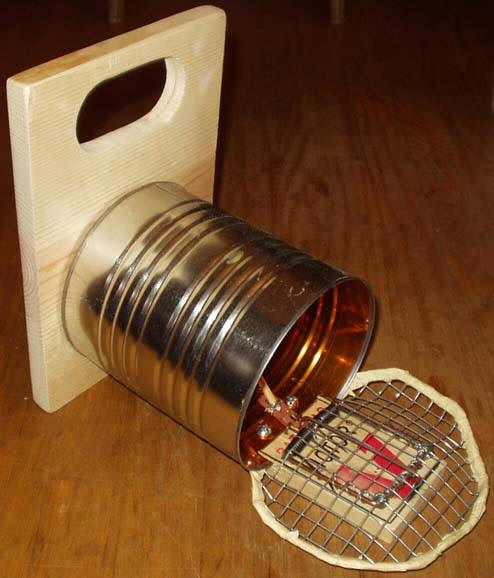
One alteration we did the past few years was to have the QB actually "hop" backwards setting his feet in the ground with the proper relationship.  I had a QB, who was actually just a backup, that had trouble with midline for some reason.  He was always getting dinged or bounced around from being to close to the mesh.  I saw Georgia Tech utilizing this hop method for their QB Josh Nesbitt, and thought maybe I should try it for midline and see what happens.  Well, it worked, and many of the other QB's used it from then on out.  I taught both, but most of the QB's preferred to "hop" instead of step out.  All of the QB's who used this hop, said it helped them get their reads quicker than stepping.  Nothing like building a better mousetrap!!!


Outside Veer
The OSV, for me, was a little used weapon.  That had to change with the reemergence of some odd front nemesis such as the 3-3/3-5.  Rarely did we use a TE in our offense, as we usually never had one, so our answer was to use Navy's "Heavy" formation, or for us what we called "Tackles".  Basically put it's just a tackles over unbalanced formation. 


Tackles Over Formation (Navy/GT's "Heavy")

From this set, we ran the OSV.  I will honestly say, we cheated on this one here!  What I did was instead of teaching my QB all new steps, I reduced the distance he had to travel, yet kept the play hitting 1 hole wider than ISV.  Our offensive line was taught anytime we were in tackles, the heavy side was to reduce their splits down to 1 foot.  This put the mesh between the QB and FB at the exact same position as ISV, however the way we blocked it was for OSV and we read 1 defender wider than ISV.  This kept things simple and easy, so that the QB's steps were identical to ISV.  I'm no genius, I stole that idea from, what was formerly a free site to go and exchange flexbone ideas, the Flexbone Association.  Don't expect to get anything from there if you don't want to pay for it.  An even better site is The Option Football Society.  Sites like this helped me see, that OSV doesn't have to be real complicated.  I can honestly say, it was a big ticket item for us against those odd fronts, and it really made their lives miserable defending that play from our Tackles formation.


In my next post, I'm going to go over some of the drills and techniques I used when coaching the point method to the triple option QB.  Keep yer' ears peeled for my next installment!


Duece